

Part 1, Inside the Circle
Until it’s not, trouble is abstract. The suffering caused by Covid-19, the sickness and death, the loss of jobs and evictions, can seem just pictures on a screen or in a newspaper unless they affect those we know personally. In my immediate world, however, the circles of pain are closing in, and they are not abstract. Chemeka, one of the young mothers I worked with in a support program at Project Row Houses, has Covid-19; so do her three children and her parents. Anna, a woman who does housework for us, has Covid-19. The wife of Gary, our handyman, is out of work because many of his tools were recently stolen. Billie, my exercise instructor, is also out of work because the community center where she taught her classes is closed. Ahmed, a refugee from Ethiopia with a family, helped by some of us from our church, has been out of work for months and may soon lose essential benefits and thus his apartment. Our friends Joy and Charlie are reported to have three family members with Covid-19. Bette, my sister, was diagnosed with breast cancer about a month ago; Mark, her husband was told last Friday he has three heart arteries that are 100% blocked. Both have surgery this week. Sue, my step-mother, is locked in a retirement home and sees relatives only through her window. Never before could I have listed so many people in my circle who are suffering. And yet my circle is better off than so many others.
The good news is that I see circles of community enfold these people. Volunteers who worked with Chemeka at Project Row Houses take food and supplies to her front porch. Anna’s clients pay her when she can’t come to work; Gary’s clients advance him money; Billie’s students pay her to come to their houses for socially-distanced and masked classes. My husband, Thorpe, monitors Ahmed’s situation, and others are ready to contribute money. The bonds of community are holding these circles together.
The suffering outside my circle can still feel abstract, albeit frightening and horrific. The scale of distant suffering is so immense it can deaden the emotions. Because any efforts I make at ameliorating this suffering can seem miniscule, I have to work at remaining hopeful. Because cultivating human sympathy for those not close to me is a spiritual discipline, I turn to nature for renewal. I need only look out my study window.
Part 2, The Other Side of the Window
The branches of the oak tree outside my study window at some point struck out on their own years ago, tentatively at first, at barely a five-degree angle, then more bravely, taking more chances, at greater angles out from the stable, growing trunk. A few daredevils even arched downward to escape the shade of an overhanging full-leafed branch. Then, free in the light, they sprouted branches that audaciously sent up even smaller ones that thickened the space with leaves.
A few feet away, the magnolia tree, planted a decade earlier, couldn’t match the rapid growth of the oak and settled for life in its shadow. The magnolia reached up mostly at its tip and grew only a little taller each year. Yet it still managed to flower, showing its rival for the light the spectacular possibilities within limits.
Underneath them both grows a ground cover of Asian jasmine in a crowded thicket of green, revealing the tenacity of the down-to-earth. Like the towering oak, it, too, is a bit of a bully, crowding out the Lilies of the Nile that used to dominate the circle around the base of the oak tree. Now the lilies struggle and thin a bit more each year. But Raul, the plant-whisperer, heard their distress, and dug up clumps of lilies to start a new colony in the nearby, sunnier flower bed. There lilies grow and flower like adolescents showing their muscles to aging parents.
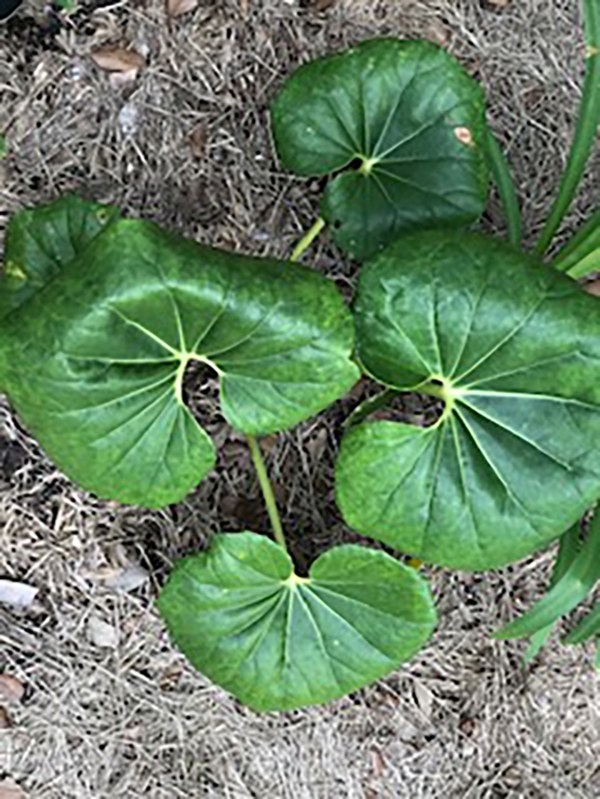
Near the lilies is the hero of them all, a plant I don’t even know the name of. It grows in lush clumps around the city, an immigrant from Asia no doubt. I have admired it for years in Hermann Park’s Japanese Garden and within the grounds of the Menil Museum. One day a year ago Thorpe and I were walking in our neighborhood when I spotted a big mound of this plant in a flower bed in the front of a house. I rang the doorbell and asked the woman if she knew the name of the plant. She did not, but generously offered to dig me up a bit of it. There were two plants in the clump of dirt she gave us. Thorpe and I took them home, then planted and watered them day after day. But the trauma of movement and the July sun were too much for them. Before long, they looked dead.
Summer finally gave way to fall and then to periodic winter cold snaps. The flower bed mostly remained ignored. When I did walk out to see how the plants were faring, occasionally I noticed with some guilt the lifeless brown remains of the plants I had hopefully put in the ground, probably in the wrong place at the wrong time.
In subtropical Houston, plants sometimes bud out and flower as early as late January: first the Japanese magnolias with pink flowers on leafless branches, then redbuds in February, with Mexican plums competing for attention. Then azaleas steal the show for multiple weeks, and just as they fade, hawthorn and amaryllis provide the joy of more color. So there was enough drama to pull me outside daily to observe the show. One day I noticed the smallest of small green shoots coming up from the dead remains of one of the unfortunate plants from the last July. Glory, halleluiah, I thought, and named the little shoot Resurrection. My daily inspections seemed like pilgrimages, and Resurrection rewarded me with inches of growth, new stems and leaves that spread out day by day. Its companion didn’t make it, however, but remained under the new layers of mulch and grass clippings, still decomposing as food for worms.
So the struggle for life continues outside my study window: the strong and the weak find victory or defeat, life or death. Taken in at one glance, it all seems static and fixed. However, over time it is anything but. I might be unaware of this struggle, were it not for Covid-19, rushing from rehearsal to meeting to lunch engagement or volunteer work, controlled by an appointment book and a to-do list. Now I am free to wander the garden, look out the study window, and notice the drama.
In the midst of the disintegration and suffering raging outside the boundaries of this garden, as the world transitions to a different age, I am too immersed to see which new patterns will emerge. I can only sense that some institutions, national myths, and cultural norms are changing. Like my oak, magnolia, and Asian jasmine, there are the strong and the weak, the bullying and the struggling. But somewhere I hope there is also a Resurrection determined to sprout anew and spread its fresh, green leaves. May those now suffering near and far find the same resilience.
 Houston Writers' Group